Not long ago, artificial intelligence in cybersecurity felt like something reserved for tech giants and government agencies. Today, it’s becoming a standard part of business security strategies. From automated threat detection to predictive analytics, AI is transforming how organizations defend themselves against cyberattacks. At the same time, cybercriminals are using the very same technology to launch smarter, faster, and more sophisticated attacks. That’s what makes the future AI security trends so fascinating and, honestly, a little intimidating too. Many business leaders understand that AI is important.
What they often struggle with is understanding where AI security is headed next. Which trends are likely to shape cybersecurity over the next few years? Which technologies deserve attention today rather than later? The answers matter because organizations that prepare early tend to adapt more smoothly than those scrambling to catch up. Companies like TechnaSaur are already helping businesses navigate this rapidly changing environment by integrating advanced AI-driven security solutions into modern corporate infrastructures. The future isn’t coming. It’s already arriving. And organizations that understand these emerging trends will be in a much stronger position to protect their data, employees, and customers.
Why AI Security Is Evolving So Quickly
Cybersecurity has always been a race. Attackers develop new techniques. Defenders build new protections. Attackers adapt again. The cycle continues. What AI has done is dramatically accelerate that cycle. Tasks that once took security teams hours or days can now be completed in seconds. Threat analysis, anomaly detection, malware identification, and vulnerability assessments are increasingly being automated. Unfortunately, attackers benefit from this acceleration too. They can create convincing phishing campaigns, automate reconnaissance, and launch attacks at scales previously impossible for human operators. As both sides adopt AI, cybersecurity is becoming less about reacting to incidents and more about anticipating them. That’s where future AI security trends begin to emerge.
Predictive Threat Intelligence Will Become Standard
Traditional cybersecurity often focuses on identifying attacks after they occur. Predictive threat intelligence aims to change that. Using machine learning models, organizations can analyze enormous amounts of historical and real-time data to identify patterns that suggest future threats. Think of it like weather forecasting. Businesses must stay updated with Future AI Security Trends to strengthen their cybersecurity strategy.
Meteorologists don’t wait for a storm to arrive before issuing warnings. Similarly, AI systems are increasingly capable of identifying indicators that suggest an attack may be developing. Future security platforms will likely become far better at predicting:
- Emerging malware campaigns
- Insider threat risks
- Credential compromise attempts
- Supply chain vulnerabilities
- Industry-specific attack trends
Companies such as TechnaSaur are already investing in intelligent threat detection systems that help businesses move from reactive defense toward proactive security management.n The goal isn’t simply to stop attacks. It’s preventing them from happening in the first place.
Autonomous Security Operations Centers (SOCs)
Security Operations Centers are the heart of many corporate cybersecurity programs. Traditionally, SOC teams spend countless hours reviewing alerts, investigating incidents, and responding to threats. It’s effective. But it’s also exhausting. Alert fatigue remains one of the biggest challenges facing security professionals today. Future AI security platforms will increasingly automate SOC functions through autonomous systems capable of:
- Triaging alerts automatically
- Investigating suspicious behavior
- Correlating threat data
- Prioritizing incidents
- Initiating containment measures
Human analysts won’t disappear. Instead, they’ll focus on strategic decision-making while AI handles repetitive operational tasks. Organizations partnering with TechnaSaur are already seeing the benefits of reducing manual workloads through intelligent automation. The result is faster response times and more efficient security teams.
AI-Powered Behavioral Analytics
Passwords alone are becoming less reliable indicators of user identity. After all, credentials can be stolen, purchased, or leaked. Future AI security systems will place greater emphasis on behavioral analytics. These solutions analyze patterns such as:
- Typing speed
- Mouse movement behavior
- Login timing
- Device usage habits
- Geographic access patterns
If a user’s behavior suddenly changes, the system may flag or block activity even if the correct credentials are used. It’s a fascinating shift. Security is moving beyond what users know toward understanding how users behave. That additional layer of intelligence makes unauthorized access significantly harder. Future AI Security Trends are reshaping how organizations defend against cyber threats.
The Rise of Adaptive Zero Trust Security
Zero Trust security has become one of the most discussed cybersecurity frameworks in recent years. Its basic principle is simple: Trust nothing. Verify everything. Future AI-powered Zero Trust environments will become increasingly adaptive. Rather than applying static access policies, AI systems will continuously evaluate risk levels and adjust permissions in real time. For example, an employee accessing company data from a familiar device may receive seamless access. Experts believe Future AI Security Trends will focus on automation and predictive threat detection. The same employee logging in from an unfamiliar country, device, or network might face additional verification requirements. This dynamic approach improves security without creating unnecessary friction for legitimate users. Companies like TechnaSaur recognize that balancing security and user experience will be critical moving forward.
AI Versus AI: The New Cybersecurity Battlefield
One of the most interesting future trends involves AI defending against AI-generated attacks. Cybercriminals are increasingly using artificial intelligence to:
- Generate phishing emails
- Create deepfake content
- Automate vulnerability discovery
- Mimic legitimate communications
In response, security vendors are developing AI systems specifically designed to detect AI-generated threats. This creates a fascinating dynamic. AI becomes both the weapon and the shield. Future cybersecurity solutions will likely focus heavily on identifying synthetic content, detecting machine-generated behavior, and distinguishing between human and AI interactions. The organizations that invest in these capabilities early may gain a significant security advantage.
Deepfake Detection Will Become Essential
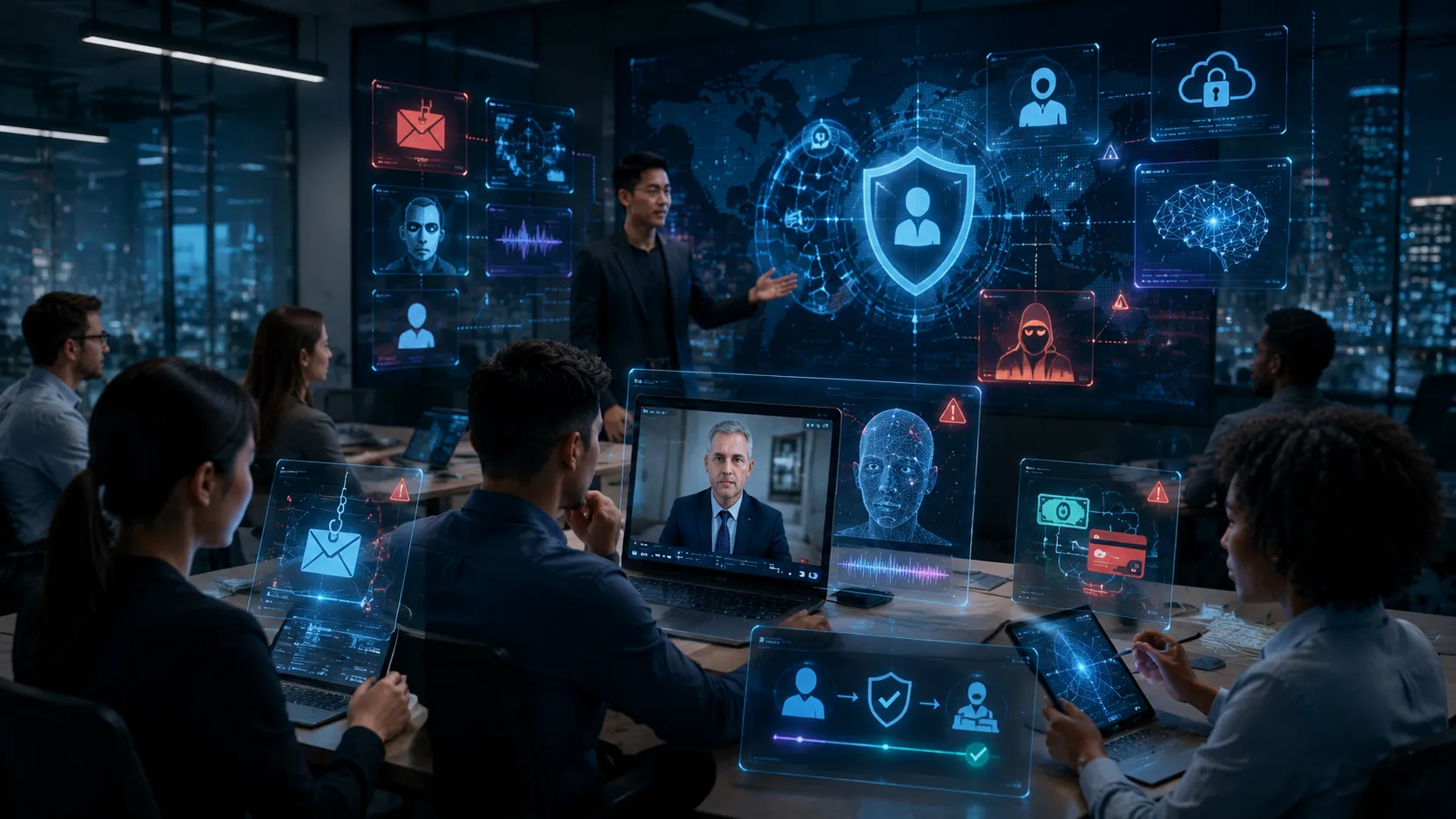
A few years ago, deepfakes seemed like a novelty. Today, they’re becoming a genuine business risk. AI-generated audio and video can now imitate executives, managers, and trusted partners with remarkable realism. Imagine receiving a video call from your CEO requesting an urgent financial transfer. The face looks authentic. Companies that follow Future AI Security Trends will gain a stronger security advantage. The voice sounds correct. The request feels legitimate. Would every employee question it? Probably not. Future AI security strategies will increasingly include deepfake detection technologies capable of identifying manipulated media before damage occurs. TechnaSaur and other forward-thinking security providers are paying close attention to this growing threat landscape. As deepfake quality improves, verification processes will become more important than ever.
Privacy-Preserving AI Security
AI systems require data. Lots of it. But collecting and processing massive amounts of information raises legitimate privacy concerns. Future security solutions will increasingly adopt privacy-preserving techniques such as:
- Federated learning
- Differential privacy
- Secure multi-party computation
- Confidential computing
These technologies allow AI systems to learn from data without unnecessarily exposing sensitive information. For corporations handling customer data, healthcare records, or financial information, this trend is especially important. Security and privacy are no longer separate conversations. They’re becoming deeply interconnected.
AI Security Governance Will Take Center Stage
As organizations deploy more AI systems internally, a new challenge emerges. Who monitors the AI? Governance is becoming one of the fastest-growing areas of cybersecurity. Future organizations will need policies governing:
- AI usage
- Data access
- Model transparency
- Bias monitoring
- Security oversight
- Regulatory compliance
AI itself introduces risks that must be managed. A poorly governed AI system can create security vulnerabilities, compliance issues, and operational risks. That’s why businesses increasingly seek guidance from cybersecurity specialists like TechnaSaur to establish governance frameworks alongside technical protections. Technology without oversight rarely ends well.
Quantum-Resistant Security Planning
Quantum computing may still feel distant, but cybersecurity leaders are already preparing for its eventual impact. Future quantum computers could potentially break many encryption methods currently protecting sensitive information. While large-scale quantum threats aren’t imminent, forward-looking organizations are beginning to evaluate quantum-resistant cryptography. AI will likely play an important role in helping companies identify vulnerable systems and manage future cryptographic transitions. Businesses that start planning early may avoid costly and rushed upgrades later. This trend may not dominate headlines today, but it’s quietly gaining momentum among security professionals worldwide.
AI-Driven Security Training and Awareness
Employee training is evolving, too. Traditional awareness programs often rely on generic presentations and annual compliance sessions. Future training platforms will use AI to personalize learning experiences. Employees may receive customized cybersecurity education based on:
- Their role
- Previous training performance
- Behavioral patterns
- Risk exposure
- Department-specific threats
This creates more relevant learning experiences and better retention. Rather than treating every employee the same, organizations can focus training where it’s needed most. TechnaSaur and similar innovators recognize that people remain one of the most important components of cybersecurity. Technology alone isn’t enough. Prepared employees remain essential. Future AI Security Trends will redefine how threats are detected and prevented.**
Continuous Risk Assessment Will Replace Periodic Reviews
Many organizations still conduct cybersecurity assessments once or twice a year. That approach is becoming outdated. Threats evolve daily. Sometimes hourly. Future AI security systems will provide continuous risk monitoring by evaluating infrastructure, applications, user behavior, and emerging threats in real time. Instead of waiting months to discover vulnerabilities, organizations can identify and address issues immediately. This shift from periodic reviews to continuous assessment may significantly improve overall resilience. It’s one of those changes that sounds small on paper but has enormous practical implications. The rise of AI is driving major changes in Future AI Security Trends across industries.
The Growing Importance of Explainable AI
As AI becomes more involved in cybersecurity decisions, organizations need to understand how those decisions are made. This is where Explainable AI (XAI) enters the conversation. Future security teams will increasingly demand transparency from AI systems. If an AI platform blocks a user, flags a threat, or initiates containment actions, security professionals need visibility into the reasoning behind those decisions. Trust grows when systems provide explanations. And in cybersecurity, trust matters. Businesses investing in AI security solutions will increasingly prioritize platforms that offer both intelligence and transparency.
Final Thoughts:
The future of cybersecurity will be shaped by artificial intelligence in ways we’re only beginning to understand. Predictive threat intelligence, autonomous security operations, adaptive Zero Trust architectures, behavioral analytics, deepfake detection, AI governance, and privacy-preserving technologies are rapidly moving from emerging concepts to practical business realities. What’s particularly interesting is that AI security isn’t simply about technology anymore. It’s about strategy. It’s about governance. It’s about culture. And perhaps most importantly, it’s about staying ahead of change. Organizations that wait until these trends become mainstream may find themselves reacting rather than leading. Businesses that begin preparing today will have more flexibility, stronger resilience, and greater confidence navigating tomorrow’s threat landscape. Companies like TechnaSaur are helping organizations make that transition by combining advanced AI-powered security capabilities with practical corporate readiness strategies. Because in the years ahead, cybersecurity won’t just be about stopping attacks. It will be about anticipating them before they ever happen. Future AI Security Trends include autonomous SOCs, deepfake detection, and predictive analytics. Future AI Security Trends are driven by automation, AI, and predictive analytics.
Frequently Asked Questions (FAQ)
1. What is the biggest future trend in AI security?
Predictive threat intelligence is considered one of the most significant emerging trends. It uses AI to identify patterns and predict potential cyber threats before they occur, helping organizations become more proactive in their defense strategies.
2. How will AI change Security Operations Centers (SOCs)?
AI will automate many routine SOC tasks, including alert triage, threat analysis, incident investigation, and response prioritization. This allows human analysts to focus on strategic decision-making and complex threat management.
3. Why is deepfake detection becoming important for businesses?
Deepfake technology can create highly realistic fake audio and video content used for fraud, impersonation, and social engineering attacks. Detecting manipulated media will become increasingly critical as deepfakes grow more sophisticated.
4. What is adaptive Zero Trust security?
Adaptive Zero Trust uses AI to continuously evaluate risk and adjust access permissions in real time. Instead of relying on static rules, it dynamically responds to changing user behavior and security conditions.
5. How does TechnaSaur help organizations prepare for future AI security challenges?
TechnaSaur supports organizations through AI-driven threat detection, security automation, governance strategies, workforce readiness initiatives, and advanced cybersecurity solutions designed to address emerging AI-powered threats.