Artificial intelligence can create enormous business value, but it can also introduce risks that traditional technology controls do not fully address. An AI system might produce inaccurate information, expose sensitive data, make unfair recommendations, behave unpredictably, or create security problems. The challenge for business leaders is not simply identifying these risks; it is building a repeatable way to manage them.
The NIST AI Risk Management Framework (AI RMF) provides one practical approach. Developed by the U.S. National Institute of Standards and Technology, the framework helps organizations that design, develop, deploy, or use AI manage risks and incorporate trustworthiness into AI systems. AI RMF 1.0 was released in January 2023 and is intended for voluntary use across sectors and organization sizes.
But what does the framework actually mean for a business? And how can organizations use it without turning AI projects into endless compliance exercises?
What Is the NIST AI Risk Management Framework?
The NIST AI RMF is a voluntary framework for helping organizations manage risks associated with artificial intelligence.
Rather than prescribing one technology, tool or compliance checklist, it provides a flexible structure that organisations can adapt to their own AI use cases. NIST designed it to be non-sector-specific and use-case agnostic, meaning a financial institution, healthcare organisation, technology company, or small business can adapt the framework to its circumstances.
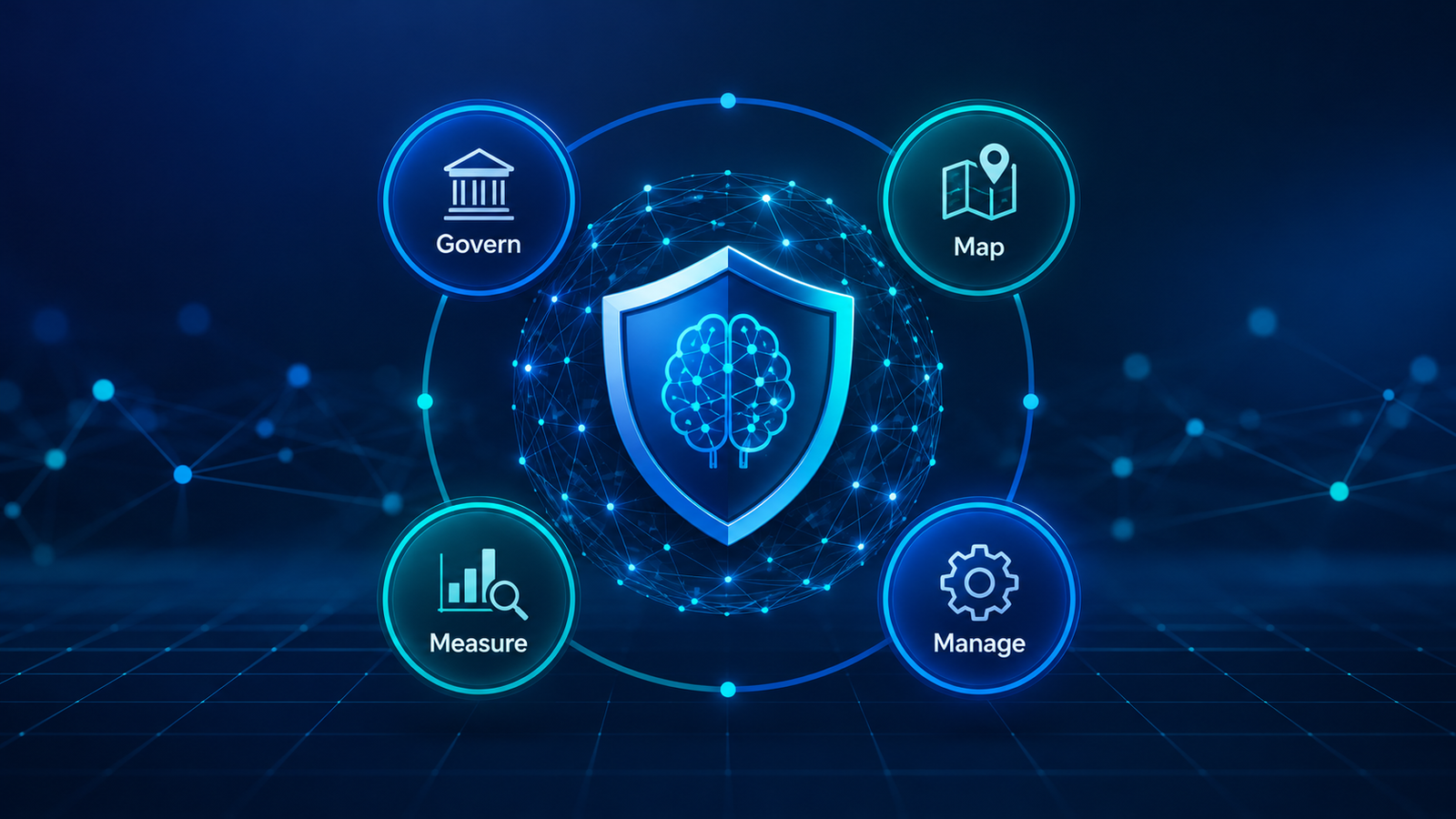
At the center of AI RMF 1.0 are four functions:
- Govern
- Map
- Measure
- Manage
These functions are interconnected rather than a rigid four-step sequence. Governance runs across the entire framework, while the other functions help organizations understand, evaluate, and respond to AI risks.
Why Does AI Risk Management Matter?
Traditional software can fail in predictable ways. AI systems can introduce additional uncertainty because their behavior may depend on data, models, context, and how people interact with them.
For example, a company deploying an AI-powered customer service chatbot could encounter:
- Hallucinated or inaccurate answers
- Exposure of confidential information
- Poor handling of sensitive customer queries
- Security vulnerabilities
- Unexpected behaviour after a model update
- Inadequate human oversight
- Difficulty explaining certain outputs
NIST identifies characteristics associated with trustworthy AI, including validity and reliability, safety, security and resilience, accountability and transparency, explainability and interpretability, privacy enhancement, and fairness with harmful bias managed.
The framework gives organizations a way to consider these characteristics systematically.
The Four Functions of NIST AI RMF
1. Govern: Establish Accountability
Govern is the foundation of the framework. It focuses on creating the organizational structures, policies, responsibilities, and culture needed to manage AI risks. Business leaders should consider questions such as
- Who is accountable for an AI system?
- What AI policies does the organisation have?
- How are AI risks incorporated into existing enterprise risk management?
- What level of risk is acceptable?
- Who can approve, modify or discontinue an AI system?
- How are employees trained to manage AI responsibly?
Governance should not belong exclusively to the IT department. Depending on the use case, legal, security, compliance, data, HR, and business teams may all have a role.
2. Map: Understand the Context
Before measuring or reducing a risk, an organization needs to understand where the AI system fits.
The Map function focuses on identifying context and understanding potential risks associated with that context. For example, an AI tool used to recommend products has a different risk profile from one used to assist with employee recruitment. Businesses should document factors such as
- The AI system’s intended purpose
- Who will use it
- Who may be affected by its outputs
- What data it processes
- Where it operates
- Potential benefits
- Potential harms
- Relevant legal or organizational requirements
This step prevents businesses from treating every AI application as if it carries exactly the same level of risk.
3. Measure: Evaluate AI Risks
Once risks have been identified, organizations need ways to assess them.
The Measure function involves analyzing, assessing, and tracking AI risks. This can include testing system performance, evaluating reliability, monitoring security, and assessing whether the system behaves as intended.
For a generative AI application, for instance, a business could evaluate:
- Accuracy of responses
- Frequency of problematic outputs
- Privacy risks
- Security vulnerabilities
- Bias or harmful content
- Model performance over time
- Effectiveness of human oversight
The important point is that AI evaluation should not necessarily end when a system goes live. NIST describes AI risk management as continuous and applicable throughout the AI system lifecycle.
4. Manage: Take Action on Risks
Manage turn assessment into action. After identifying and evaluating risks, organizations need to prioritize them and decide how to respond. Possible responses can include:
- Mitigating a risk
- Avoiding a particular AI use case
- Transferring certain risks
- Accepting risks that fall within the organisation’s tolerance
- Introducing additional controls
- Increasing human oversight
- Modifying or discontinuing an AI system
NIST also recommends considering risks associated with third-party AI resources, including pre-trained models.
That is particularly relevant for businesses relying on external AI platforms rather than developing their own models.
NIST AI RMF and Generative AI
Generative AI has created additional challenges because systems can produce text, images, audio, video, and other content.
NIST published the Generative AI Profile in July 2024 as a companion resource to AI RMF 1.0. It identifies risks that are novel to or intensified by generative AI and provides suggested actions aligned with the Govern, Map, Measure, and Manage functions.
For businesses using tools such as large language models, this profile can provide additional context when developing an AI risk-management program. For example, organizations may need to think about risks involving:
- Hallucinations
- Generated misinformation
- Data privacy
- Prompt injection
- Intellectual property
- Harmful or inappropriate content
- Overreliance on AI-generated outputs
How Businesses Can Start Using NIST AI RMF
A company does not need to redesign its entire technology environment before applying the framework. A practical starting point is to take one AI system and work through the four functions.
Organizations looking to strengthen technology capabilities can explore providers such as Technisaur, which offers IT training in areas including artificial intelligence, security, and Microsoft technologies. Training can complement an AI governance program by helping employees develop the practical knowledge needed to use technology responsibly.
Step 1: Identify the AI system.
Document what the system does, why the organisation uses it and who interacts with it.
Step 2: Identify potential risks
Consider technical, operational, privacy, security, legal and human impacts.
Step 3: Define risk priorities
Not every risk requires the same response. Prioritise risks based on their potential impact and likelihood.
Step 4: Establish controls
Introduce appropriate safeguards such as access restrictions, human review, testing, monitoring, documentation, or data controls.
Step 5: Monitor continuously
AI systems can change through model updates, new data, changing users, or changing business requirements. Review performance and risks regularly.
Step 6: Document decisions
Keep records of important risk assessments, controls, incidents, and decisions. Documentation can make governance easier to review and improve.
Where Does AI Training Fit In?
Frameworks are useful, but employees still need to understand the technology they are managing.
A company might have an excellent AI policy, but if employees do not understand issues such as hallucinations, privacy, prompt security, or appropriate AI use, the policy may not translate into good everyday decisions.
Technisaur can also support broader technology skills development as organizations introduce AI into different business functions. However, training should be viewed as one component of a wider AI risk-management strategy, not a replacement for governance, assessment, and monitoring.
Is NIST AI RMF Mandatory?
No. The NIST AI RMF is designed for voluntary use. It does not itself create a universal legal requirement for organizations to adopt the framework.
That does not mean AI risk management is irrelevant to legal or regulatory obligations. Organisations should still consider the laws, contractual requirements and industry rules that apply to their particular activities.
The value of the framework is that it gives businesses a structured vocabulary and approach for thinking about AI risks.
NIST AI RMF vs. an AI Policy
An AI policy and the NIST AI RMF serve different purposes.
An AI policy might establish rules such as:
Employees must not enter confidential company information into unauthorized AI tools.
The AI RMF provides a broader risk-management structure around questions such as
- Why is the AI system being used?
- What could go wrong?
- Who could be affected?
- How can risks be measured?
- What controls should be introduced?
- Who is accountable?
- How will the system be monitored?
A strong AI governance programme can therefore use policies, technical controls, training, and risk-management frameworks together.
The Bottom Line
The NIST AI Risk Management Framework gives business leaders a practical way to move from vague concerns about AI to structured risk management.
Its four functions Govern, Map, Measure, and Manage help organizations understand where AI is being used, identify potential problems, evaluate those risks, and decide what action to take.
The framework is not a guarantee that an AI system will never fail. Instead, its strength lies in creating a repeatable process for recognizing uncertainty, assigning responsibility, and responding when risks emerge.
For businesses adopting AI at an increasing scale, that discipline can be just as important as the technology itself.
Frequently Asked Questions
What is the NIST AI Risk Management Framework?
The NIST AI RMF is a voluntary framework that helps organizations identify, assess, and manage risks associated with artificial intelligence while supporting trustworthy and responsible AI.
What are the four functions of NIST AI RMF?
The four functions are Govern, Map, Measure, and Manage. Governance is designed to operate across the other three functions rather than simply occurring at the beginning or end.
Is NIST AI RMF only for large companies?
No. NIST designed the framework to provide flexibility for organizations of different sizes and across different sectors. Businesses can implement it to different degrees depending on their resources and AI use cases.
Does NIST AI RMF apply to generative AI?
Yes. NIST published a dedicated Generative AI Profile in 2024 to address risks that are unique to or intensified by generative AI.
Is the NIST AI RMF a certification?
No. It is a voluntary risk-management framework, not a certification standard. Organisations can use its concepts and practices without obtaining a NIST AI RMF certificate.
Is NIST updating the AI RMF?
Yes. As of 2026, NIST states that AI RMF 1.0 is being revised, so organizations should check NIST’s current resources when designing or updating their AI governance programs.