
Artificial intelligence can help businesses automate routine work, analyze information, support decisions, and create new products. But as AI moves from experimentation into everyday operations, another question becomes harder to ignore: Who is responsible when an AI system makes a mistake?
That is where an AI governance framework comes in. Good governance gives organizations a structured way to decide how AI can be used, what risks must be managed, who is accountable, and how systems should be monitored over time.
For businesses adopting generative AI, governance should not be treated as paperwork that slows innovation. Done properly, it creates the guardrails that allow employees to use AI confidently without leaving privacy, security, compliance, or ethical decisions to chance.
What Is an AI Governance Framework?
An AI governance framework is a set of policies, responsibilities, processes, and controls that guide how an organization develops, purchases, deploys, and uses artificial intelligence. A practical framework typically addresses:
- Accountability: Who owns an AI system and its outcomes?
- Risk management: What could go wrong, and how serious could the consequences be?
- Data governance: What information can AI systems access or process?
- Security: How will AI-related threats and vulnerabilities be managed?
- Transparency: When should employees, customers, or other stakeholders know that AI is being used?
- Human oversight: When must a person review or approve an AI-generated result?
- Compliance: Which laws, regulations, contractual requirements, or internal policies apply?
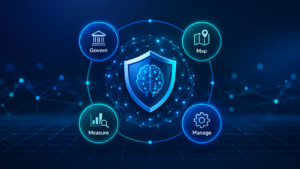
NIST’s AI Risk Management Framework provides one widely used voluntary approach. Its core is organized around four functions: Govern, Map, Measure, and Manage, with governance operating across the other risk-management activities.
Why Do Businesses Need AI Governance?
The risks associated with AI are not limited to incorrect answers. An employee might accidentally paste confidential information into an AI application. A hiring system could produce unfair outcomes.
A generative AI tool could create inaccurate information that later appears in a customer communication. An AI-powered application could also introduce security or privacy concerns through its data sources and integrations.
Without clear policies, different departments may make completely different decisions about acceptable AI use. A governance framework creates a common standard. It also helps leadership answer practical questions such as:
- Which AI tools are approved?
- What information can employees enter into them?
- Which AI applications require additional review?
- Who evaluates vendors?
- What happens when an AI system produces an unsafe or incorrect result?
- How frequently should AI systems be reassessed?
The Core Components of an AI Governance Framework
1. Establish Clear Ownership
AI governance needs named responsibilities. A business might create an AI governance committee involving representatives from IT, cybersecurity, legal, compliance, HR, data management, and relevant business units.
Smaller organizations may not need a formal committee, but someone should still have responsibility for AI oversight. Responsibilities can include:
- Approving high-risk AI use cases
- Maintaining an inventory of AI systems
- Reviewing vendors
- Monitoring incidents
- Updating internal policies
- Coordinating employee training
The objective is simple: AI responsibility should never belong to everyone and therefore not to anyone.
2. Create an AI Use Policy
Employees need clear guidance about acceptable and unacceptable AI use. For example, an internal policy might specify that employees may use approved AI tools for drafting, brainstorming, summarization, and other low-risk tasks, while requiring additional approval for applications involving sensitive personal information, employment decisions, financial decisions, or other high-impact activities.
The policy should also explain what employees should do when they are unsure. A policy that is technically comprehensive but impossible for employees to understand will not provide much protection.
3. Classify AI Risks
Not every AI application deserves the same level of scrutiny. A useful approach is to classify systems according to potential impact. A marketing employee using AI to generate headline ideas presents a different risk profile from an AI system used to screen job candidates or support medical decisions. Organizations can consider factors such as
- Sensitivity of the data involved
- Number of people affected
- Potential financial or reputational impact
- Degree of human oversight
- Legal or regulatory requirements
- Security implications
- Difficulty of reversing a harmful decision
NIST emphasizes that AI risk management should be adaptable to organizations of different sizes and sectors rather than functioning as a one-size-fits-all checklist.
Build AI Literacy Across the Organization
Governance does not work if employees do not understand the technology they are being asked to use responsibly.
Training should cover more than how to write effective prompts. Employees should understand basic concepts such as hallucinations, data privacy, model limitations, verification, intellectual property, and appropriate human review.
For businesses building these capabilities, AI and technology learning resources from Technisaur can serve as an additional resource for developing practical technology knowledge alongside an organization’s internal AI policies.
Training can then be tailored to different departments. A marketing employee may need guidance on content verification and copyright considerations, while a finance team may require stronger controls around confidential financial information.
4. Maintain an AI Inventory
Businesses cannot govern systems they do not know they are using. An AI inventory should ideally record:
- The name and purpose of each AI system
- Business owner
- Vendor or developer
- Data processed
- Intended users
- Risk classification
- Human oversight requirements
- Approval status
- Review date
This inventory should include officially purchased tools as well as AI applications introduced through third-party software.
Shadow AI: Employees independently using AI tools without organizational approval can create significant governance gaps. The solution is not necessarily to ban every tool. A clearer approval process and practical employee guidance can make responsible adoption easier.
5. Measure and Monitor AI Systems
Approval should not be the end of the governance process.
AI systems can change as models, data, integrations, or business conditions change. Organizations should therefore establish ongoing monitoring appropriate to the system’s risk.
Useful measures might include:
- Accuracy and error rates
- Security incidents
- Unexpected outputs
- Bias or performance differences
- User complaints
- Privacy incidents
- Changes to the underlying model or vendor service
NIST’s framework specifically treats AI risk management as a continuous activity throughout the AI system lifecycle.
6. Prepare an AI Incident Response Process
Even well-designed controls cannot eliminate every AI-related problem.
Businesses should decide in advance what happens when an AI system generates harmful content, exposes sensitive information, produces materially inaccurate results, or behaves unexpectedly.
A basic response process can include:
- Identify the incident.
- Contain the affected system or workflow.
- Assess the potential impact.
- Escalate to the appropriate teams.
- Document what happened.
- Correct the underlying issue.
- Review the controls to prevent recurrence.
This turns an unexpected AI failure into a manageable business process rather than an improvised crisis.
How Can a Business Start an AI Governance Program?
A company does not need a massive governance department on day one. A practical starting point is
Step 1: Identify where AI is already being used.
Step 2: Categorize those applications according to risk.
Step 3: Create an initial acceptable-use policy.
Step 4: Assign owners for important AI systems.
Step 5: Establish rules for sensitive data.
Step 6: Introduce employee AI-literacy training.
Step 7: Monitor high-risk applications and review the framework regularly.
Organizations can then expand their controls as their AI adoption matures. NIST’s AI RMF is explicitly designed to be flexible and can be adapted to different organizational capabilities and use cases.
Final Thoughts
AI governance is not about preventing employees from using artificial intelligence. It is about making AI adoption deliberate rather than accidental. Businesses that establish clear ownership, risk classifications, data rules, employee training, monitoring, and incident procedures can create a stronger foundation for responsible AI adoption. As AI becomes embedded in everyday workflows, governance should evolve with it. The most effective framework is not necessarily the most complicated one. It is the one employees understand, leadership supports, and the organization actually uses.
Frequently Asked Questions
What is AI governance?
AI governance is the system of policies, roles, processes, and controls an organization uses to manage artificial intelligence responsibly throughout its lifecycle.
Who should be responsible for AI governance?
Responsibility should involve leadership and relevant functions such as IT, cybersecurity, legal, compliance, HR, data teams, and business owners. The exact structure depends on the organization’s size and risk profile.
Is an AI governance framework legally required?
Not universally. Requirements vary by jurisdiction, industry, use case, and the type of AI system involved. Businesses should assess the laws and regulations applicable to their operations rather than assuming that a single framework satisfies every legal obligation.
What is the NIST AI Risk Management Framework?
The NIST AI RMF is a voluntary framework designed to help organizations manage AI risks and promote trustworthy and responsible AI. Its four core functions are Govern, Map, Measure, and Manage.
How often should an AI governance framework be reviewed?
There is no universal review interval for every organization. High-risk systems may require more frequent reviews, particularly after significant changes to models, data, vendors, integrations, or applicable requirements.