
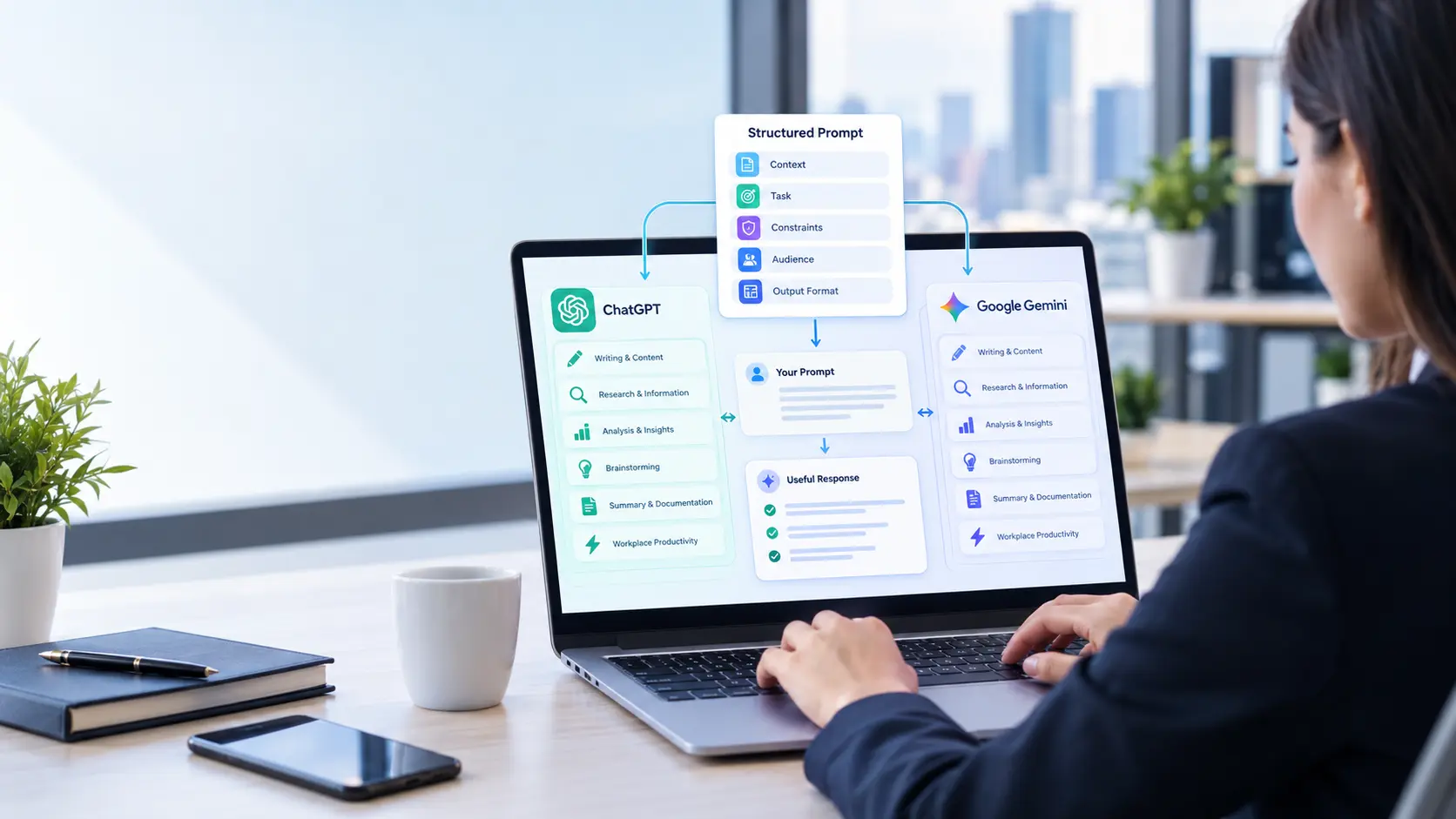
A good AI response rarely comes from a vague request. Ask an AI assistant to “write a report,” and you may receive something usable but probably not something tailored to your audience, goals, data, or business context. The difference between an average AI output and a genuinely useful one often comes down to prompt engineering. For business professionals, prompt engineering is less about finding clever commands and more about communicating clearly with AI. The same principle applies whether you use ChatGPT, Google Gemini, or another generative AI tool.
Understanding how to structure prompts can help professionals produce better drafts, analyze information, summarize documents, brainstorm ideas, and streamline repetitive parts of their workflow. But which platform is better for business use, ChatGPT or Google Gemini? The answer depends largely on how your organization works.
What Is Prompt Engineering for Business?
Prompt engineering is the practice of designing instructions that guide an AI system toward a specific, useful result. A strong business prompt usually provides four things:
- Context: What situation is the AI working within?
- Task: What exactly should it do?
- Constraints: What should it include, avoid, or follow?
- Output format: Should the response be an email, report, checklist, summary, or presentation outline?
For example, instead of asking
“Write a sales email.”
A professional might write the following:
“Draft a 150-word follow-up email for a potential B2B client who requested pricing last week. Keep the tone professional and friendly, avoid aggressive sales language, and end with one clear call to action.”
The second prompt gives the AI a much clearer target.
Why Prompt Engineering Matters at Work
Business professionals often work with incomplete information, tight deadlines, and different audiences. AI can accelerate these tasks, but poor instructions can create equally poor results.
Consider a marketing manager preparing a campaign brief. Rather than asking AI to “create a marketing strategy,” they can provide the target audience, product, campaign objective, budget limitations, preferred channels, and desired format. This produces a more structured starting point and gives the professional something concrete to review and improve. Prompt engineering can be particularly useful for:
- Drafting and editing business communications
- Summarizing lengthy documents
- Brainstorming marketing campaigns
- Analyzing customer feedback
- Creating meeting agendas
- Turning notes into structured reports
- Generating interview questions
- Developing presentation outlines
- Comparing strategic options
The key is to treat AI as a tool that needs direction, not as a mind reader.
ChatGPT vs. Google Gemini for Business
ChatGPT and Google Gemini overlap in many business use cases, but their strengths can feel different depending on the tools an organization already uses.
Where ChatGPT Can Fit
ChatGPT can be useful for writing, analysis, brainstorming, coding, research-oriented tasks, and multi-step workflows. OpenAI also provides business-oriented controls, including workspace administration, user roles, analytics, encryption, and business data protections.
For professionals who frequently move between different types of tasks, this broad flexibility can be valuable. A single conversation might involve turning rough meeting notes into an executive summary, refining the language, generating follow-up questions, and producing a presentation outline.
Where Google Gemini Can Fit
Gemini can be especially attractive to organizations already deeply invested in Google Workspace. Google integrates Gemini into applications such as Gmail, Docs, Drive, Sheets, and Meet, depending on the organization’s plan and configuration.
That integration matters because productivity is not only about the quality of an AI model. It is also about where the work happens.
If a company’s employees spend most of their day inside Gmail, Docs, Drive, and Sheets, having AI capabilities directly within those applications may reduce the friction of switching between tools.
Google’s Workspace approach also provides organizational controls and data protections designed for business environments, making it important for companies to evaluate the specific plan and settings they use.
Which One Should a Business Choose?
There is no universal winner.
A business should evaluate the platforms based on its existing software environment, security requirements, workflows, budget, administrative needs, and the tasks employees actually perform.
A simple comparison can help:
Choose based on workflow, not hype.
If your team primarily needs a flexible AI assistant for writing, reasoning, analysis, brainstorming, and varied tasks, ChatGPT may be a strong fit.
If your organization already relies heavily on Google Workspace and wants AI capabilities embedded throughout that environment, Gemini may be more convenient.
In practice, the most important question may not be “Which AI is better?” but “Which AI fits the way our employees already work?”
How to Write Better AI Prompts
Professionals can improve results without learning complicated technical terminology. Try this five-step approach:
- Define the role. Tell the AI what perspective it should take, such as a financial analyst, HR manager, or marketing strategist.
- Explain the context. Provide the information needed to understand the situation.
- State the objective. Be explicit about what you want produced.
- Set constraints. Specify length, tone, audience, format, deadlines, or information that must be excluded.
- Ask for a review step. For important work, ask the AI to identify assumptions, missing information, or potential weaknesses before producing the final version.
For professionals who want to build stronger AI skills beyond individual experiments, resources focused on practical AI and ChatGPT learning can provide a useful starting point, including the technology education resources available from Technisaur.
Common Prompt Engineering Mistakes
Even experienced users can make prompts unnecessarily complicated. One common mistake is providing too many instructions that contradict each other. Another is assuming the AI knows internal company context that has never been provided.
Professionals should also avoid blindly accepting generated information. AI output should be reviewed, particularly when it involves financial decisions, legal matters, confidential information, or business-critical facts.
A useful workflow is the following:
Prompt → Review → Verify → Refine → Use
That final human review is not a weakness of AI. It is part of responsible AI-assisted work.
Final Thoughts
Prompt engineering is becoming less about discovering a perfect sentence and more about developing a disciplined way of working with AI. For business professionals, the goal is not to make AI replace judgment. It is to make AI more useful by giving it better direction and then applying human judgment to the result. Whether a company chooses ChatGPT, Gemini, or both, employees who understand how to communicate effectively with AI will be better positioned to turn these tools into practical workplace capabilities.
Frequently Asked Questions
What is prompt engineering?
Prompt engineering is the process of creating clear, structured instructions that guide an AI system toward a desired result. In business, it often involves defining the task, context, constraints, audience, and output format.
Is ChatGPT or Gemini better for business?
Neither is automatically better for every business. ChatGPT may suit teams looking for a broadly flexible AI assistant, while Gemini can be particularly convenient for organizations deeply integrated with Google Workspace. The right choice depends on workflow, tools, security requirements, and business needs.
Can prompt engineering improve AI accuracy?
Better prompts can improve relevance, clarity, and consistency, but they cannot guarantee factual accuracy. Important information should still be independently verified.
What should a business prompt include?
A useful prompt can include the task, relevant context, intended audience, desired tone, constraints, source material, and expected output format. The more important the task, the more useful it is to define these elements clearly.
Can non-technical employees learn prompt engineering?
Yes. Basic prompt engineering does not require programming knowledge. Most professionals can improve their results simply by learning how to give AI clearer instructions, provide useful context, and evaluate the resulting output.