Artificial intelligence can make a business faster, more efficient, and more capable. But speed is not the same as responsible innovation. An AI system can produce an inaccurate recommendation, expose sensitive information, reinforce bias, or make a decision that employees struggle to explain.
That is why responsible AI needs to be treated as an organisational responsibility rather than simply a technical issue. Businesses need practical principles that guide how AI is selected, developed, deployed, and monitored.
Responsible AI is ultimately about answering a straightforward question: How can an organization benefit from AI while protecting the people, information, and interests affected by it?
What Does Responsible AI Mean?
Responsible AI refers to developing and using artificial intelligence in ways that are safe, fair, transparent, accountable, privacy-conscious, and appropriate for its intended purpose.
There is no single checklist that works perfectly for every organization. A chatbot used for internal brainstorming does not require the same controls as an AI system influencing hiring, lending, healthcare, or other high-impact decisions.
However, several principles provide a strong foundation.
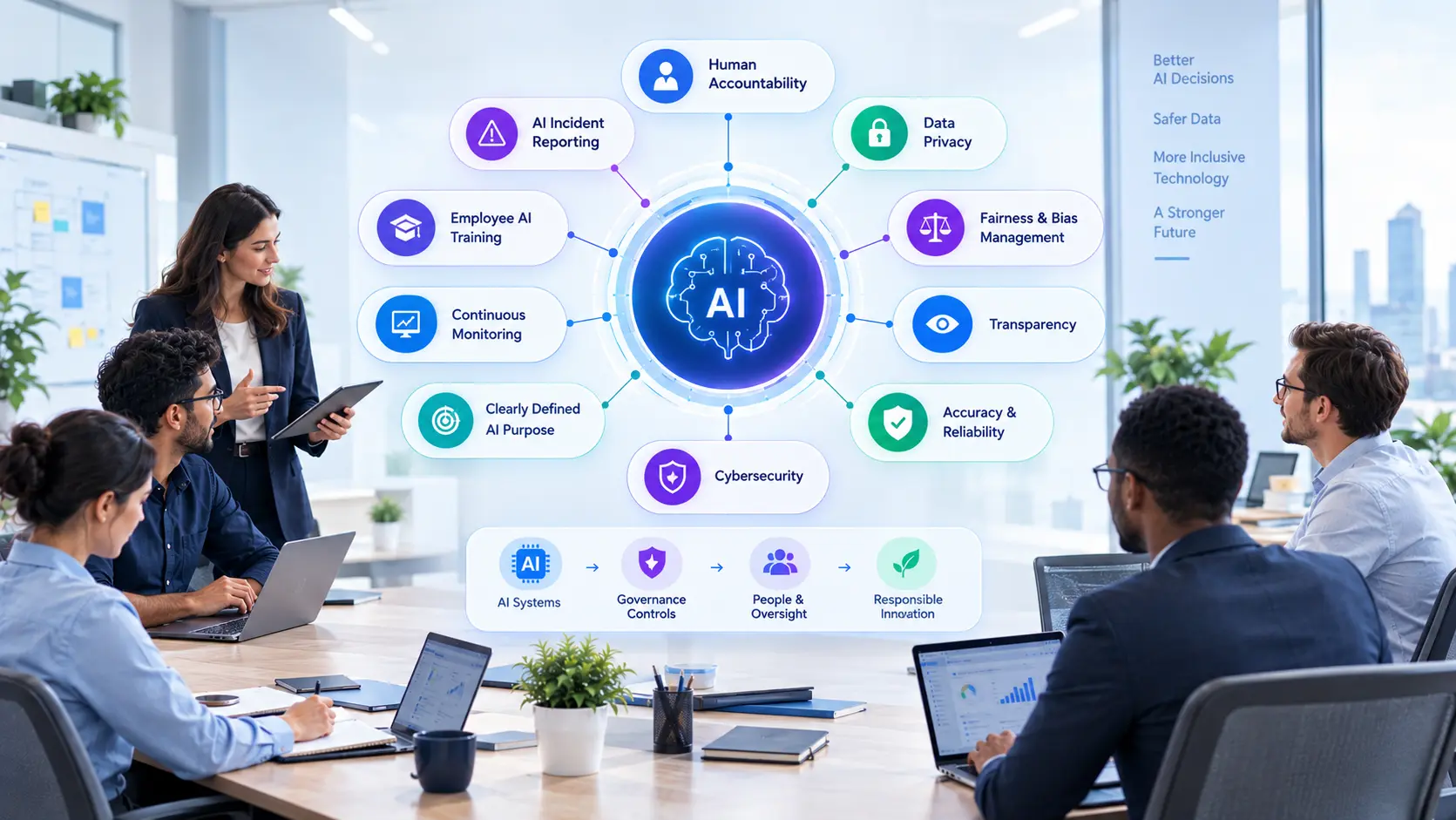
1. Put Human Accountability First
AI should not become an excuse for avoiding responsibility. An organization should identify who owns each significant AI system and who is accountable for its outcomes. Employees should also understand when human review is required.
For high-impact decisions, human oversight can be particularly important. A person should have enough information, authority, and competence to question or override an AI-generated recommendation when necessary.
The goal is not to have humans blindly approve everything AI produces. It is to ensure that responsibility remains with people rather than disappearing behind an algorithm.
2. Protect Personal and Sensitive Data
AI systems often process large amounts of information, making data governance a central part of responsible AI. Before employees enter information into an AI tool, organizations should establish clear rules about what is permitted.
Depending on the circumstances, this may include customer information, employee records, confidential documents, financial information, intellectual property, or commercially sensitive material. Practical safeguards include:
- Limiting AI access to information that is genuinely necessary
- Applying appropriate access controls
- Reviewing how vendors handle submitted data
- Avoiding unnecessary personal information
- Establishing retention and deletion procedures
- Training employees on acceptable AI use
Responsible AI starts with treating data as something that requires protection, not simply as fuel for automation.
3. Test AI Systems for Bias and Fairness
AI systems can reproduce or amplify problems present in their training data, design, or deployment environment. Organizations should therefore consider whether an AI system performs differently across relevant groups and whether its outputs could create unfair disadvantages.
For example, an organization introducing AI into recruitment should not simply ask whether the system saves recruiters time. It should also examine whether its recommendations are producing problematic patterns and whether human reviewers can identify and challenge them.
Fairness is not always a single mathematical target. Different applications may require different definitions, measurements, and safeguards.
4. Be Transparent About AI Use
People should not be unnecessarily left guessing about whether AI is involved in a process that affects them.
Transparency can take different forms. An organization might disclose that customer support uses an AI assistant, explain when an AI-generated decision is subject to human review, or document how an internal AI system is intended to be used.
Transparency also means being honest about limitations. If an AI system is not designed to provide definitive answers, employees should know that. If its output requires verification, that expectation should be communicated clearly.
5. Verify Accuracy and Reliability
An AI-generated answer can sound convincing while still being wrong. This is especially important when AI is used to create reports, summarize information, conduct research, or support business decisions.
Organizations should establish verification procedures appropriate to the risk involved. A marketing brainstorm may require a quick human review, while information used in a legal, financial, safety-critical, or regulatory context may require substantially stronger validation.
Employees should learn to distinguish between AI-generated content and verified information. For organizations building practical AI and technology skills, Technisaur’s AI and technology training resources can complement internal training by providing learning options across areas such as artificial intelligence, cybersecurity, Microsoft technologies, and other workplace technologies.
6. Design for Security
Responsible AI and cybersecurity are closely connected. AI applications can introduce risks through their models, integrations, data sources, permissions, and user interactions.
Organizations should therefore consider security throughout the AI lifecycle rather than treating it as an afterthought. Security measures may include:
- Restricting access according to user roles
- Monitoring unusual activity
- Protecting confidential data
- Assessing third-party AI vendors
- Testing systems for misuse
- Keeping relevant software and integrations updated
Security requirements should become stricter as the potential consequences of misuse increase.
7. Give AI a Clearly Defined Purpose
One of the easiest ways to create unnecessary risk is to deploy AI simply because it is available. Before introducing an AI system, an organization should be able to explain:
What problem is this system solving?
A clearly defined purpose makes it easier to determine what data the system needs, what success looks like, what risks are acceptable, and where human oversight belongs.
For example, “use AI in customer service” is too broad to govern effectively. “Use an AI assistant to draft responses to routine customer enquiries, with employees reviewing responses before sending” creates a much clearer boundary.
8. Monitor AI After Deployment
Responsible AI does not end when a system goes live.
Performance can change as data, users, business processes, vendors, and underlying models change. A system that worked appropriately six months ago may need reassessment after a significant modification.
Organizations should establish monitoring based on the system’s risk level. Useful indicators can include:
- Accuracy and error patterns
- User complaints
- Unexpected outputs
- Security incidents
- Bias-related concerns
- Changes in system performance
- Significant model or vendor changes
The NIST AI Risk Management Framework emphasizes ongoing governance and risk management throughout the AI lifecycle.
9. Give Employees Practical AI Training
A responsible AI policy is unlikely to work if employees do not understand it.
Training should go beyond teaching people how to write better prompts. Employees should understand AI limitations, data privacy, verification, security, bias, acceptable use, and when to involve a human decision-maker.
Different departments may need different guidance. A marketing team, HR department, software team, and finance department will encounter different AI risks. Practical training makes responsible AI part of everyday work rather than a document that employees read once and forget.
Technisaur can also be considered a supplementary technology-learning resource for organisations developing employee skills around AI and broader workplace technologies.
10. Create a Process for Reporting AI Problems
Employees need to know what to do when something goes wrong. An organization should provide a clear way to report problems such as
- Incorrect or harmful AI outputs
- Potential privacy breaches
- Unexpected system behavior
- Biased recommendations
- Security concerns
- Suspected misuse of AI tools
Reports should be documented, assessed, and used to improve controls. A strong reporting culture is especially important because employees are often the first people to notice when an AI system behaves differently from what was expected.
How Can Organizations Put Responsible AI Into Practice?
Responsible AI principles become more useful when converted into everyday processes. A practical approach is to:
- Identify where AI is currently being used.
- Classify systems according to their potential risk.
- Assign clear ownership and accountability.
- Set rules for data, security, transparency, and human oversight.
- Train employees according to their roles.
- Test and monitor AI systems throughout their lifecycle.
- Review and improve policies when technology, risks, or business requirements change.
This does not require every organization to create an enormous bureaucracy. Controls should be proportionate to the potential impact of the AI application.
Final Thoughts
Responsible AI is not about slowing technological progress. It is about making sure progress does not come at the expense of privacy, fairness, security, or accountability.
The strongest organizations will treat responsible AI as an ongoing practice. They will define clear boundaries, train their people, monitor systems, question unexpected results, and adjust their controls as AI technology develops.
When responsible principles become part of everyday decision-making, businesses can pursue the benefits of AI with greater confidence and with a clearer understanding of the responsibilities that come with it.
Frequently Asked Questions
What are the main principles of responsible AI?
Common principles include accountability, fairness, transparency, privacy, security, reliability, human oversight, and responsible governance. The appropriate emphasis depends on the AI system and its potential impact.
Why is responsible AI important for businesses?
Responsible AI helps organizations manage risks associated with inaccurate outputs, privacy, bias, security, and inappropriate decision-making while creating clearer expectations for employees and stakeholders.
Who is responsible for responsible AI?
Responsibility should be shared across relevant business functions, but individual AI systems should have clearly identified owners. Leadership, IT, legal, security, compliance, data teams, and business units may all have important roles.
Can AI be completely unbiased?
No AI system should automatically be assumed to be unbiased. Organizations need to evaluate potential sources of bias, test relevant systems, monitor outcomes, and establish appropriate safeguards.
How can a business start implementing responsible AI?
Start by creating an inventory of current AI use, identifying higher-risk applications, establishing an acceptable-use policy, assigning ownership, training employees, and introducing monitoring and incident-reporting procedure.